
When Is a Metal 3D Printing Service More Practical Than Traditional Machining?

Traditional machining works well for many industrial parts, but certain designs can make the process expensive, time-consuming, or difficult to complete. Engineers sometimes need components with internal passages, unusual shapes, or features that cutting tools cannot easily reach. A metal 3D printing service offers another manufacturing option by building parts layer by layer, allowing manufacturers to produce designs that would otherwise require several machining operations or separate components.
1. When a Part Needs Internal Channels or Complicated Geometries
Cutting tools need enough space to reach the surfaces they machine, which limits the shapes manufacturers can produce from solid metal. Deep internal passages, curved channels, and enclosed cavities often require several machining operations or separate pieces that workers must join afterward. These restrictions become especially noticeable in heat exchangers, fuel manifolds, and aerospace components.
Laser powder bed fusion creates these features during the printing process instead of cutting them into finished metal. Engineers can design cooling passages that follow a component’s shape or place fluid channels exactly where needed. However, they must still account for unsupported surfaces, trapped powder, and access for cleaning.
2. Manufacturing Small Batches Without the Cost of Tooling
Production volume often determines which manufacturing method makes financial sense. CNC machining can produce individual parts without expensive molds, although specialized fixtures, complex programming, and repeated setups may increase costs for unusual designs.
Metal additive manufacturing becomes attractive when manufacturers need small quantities of complicated parts. A digital design can guide production without dedicated forming tools, making the process suitable for prototypes, replacement components, and specialized equipment.
Businesses comparing metal 3D printing Huntsville AL services with conventional manufacturing should consider the complete cost per finished part. Printing equipment, powder handling, heat treatment, inspection, and finish machining all affect pricing. Simple parts with accessible features may still cost less to machine, even in small quantities.
3. Reducing Material Waste When Working With Expensive Metals
High-performance alloys can be expensive to purchase and difficult to machine. Producing a component from a large metal billet may involve cutting away substantial amounts of material, particularly when the finished part has a low weight compared with its starting stock.
Powder metal 3D printing builds material primarily where the design requires it, which can reduce the amount of metal removed during production. Unmelted powder may also be recovered and reused when it meets established quality requirements.
Material savings depend on the actual design and manufacturing process. Support structures, failed builds, powder losses, and post-processing still generate waste. Manufacturers working with costly alloys such as Inconel 718 can benefit most when the printed geometry significantly reduces machining requirements.
4. Making Lightweight Components Without Sacrificing Structural Strength
Aircraft, spacecraft, and mobile industrial equipment often benefit from lighter components. Lower weight can reduce loads on surrounding structures, improve fuel efficiency, or create more room for other equipment.
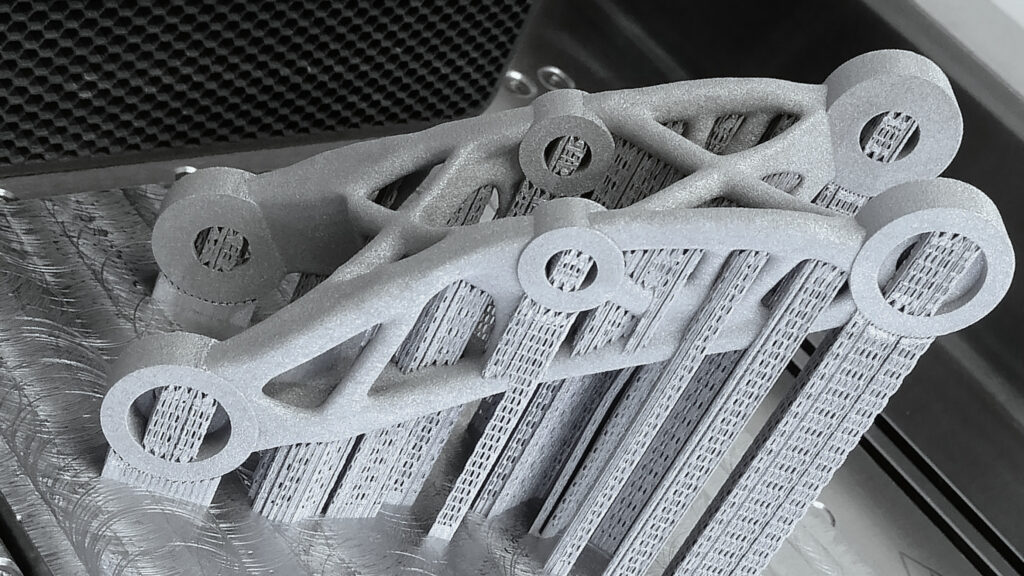
Additive manufacturing for metals allows engineers to remove material from areas that carry little load while maintaining strength where the component needs it. Lattice structures, hollow sections, and topology-optimized shapes help achieve this balance without relying on uniformly thick walls.
Weight reduction does require careful engineering. Printed parts can behave differently depending on build orientation, material properties, and internal defects. Testing and inspection help determine whether a lighter design meets its operating requirements.
5. Replacing Multiple Machined Components With a Single Printed Part
Complex industrial assemblies may contain several machined pieces connected by bolts, welds, or fittings. Each connection introduces additional manufacturing steps, alignment requirements, and potential maintenance concerns.
Metal additive manufacturing can combine these individual parts into one component when the geometry and operating conditions permit. A fluid manifold, for example, may incorporate several passages and mounting features within a single printed body.
Fewer connections can reduce assembly labor, eliminate certain leak paths, and simplify inventory management. Still, engineers must consider whether the finished component can be inspected, cleaned, repaired, or replaced economically. Combining everything into one piece is not always the better choice, particularly when individual sections experience different wear rates.
6. Speeding Up Prototype Development When Designs Keep Changing
Product development involves adjustments that manufacturers cannot always predict at the beginning. An engineering team might change the location of a mounting hole, revise an internal passage, or reduce the weight of a prototype after testing.
Digital manufacturing makes many of these revisions easier to manage because updated CAD files can guide the next build. Instead of creating new dedicated tooling, engineers can adjust the design and produce another version, provided it meets the printing equipment’s capabilities.
For companies seeking Huntsville additive manufacture capabilities, access to specialized equipment and engineering support can help shorten certain prototype development cycles. However, printing does not eliminate production planning, material testing, or finishing requirements.
In Huntsville, AL, Additive Manufacturing & Engineering, Inc provides industrial metal 3D printing services for businesses developing complex metal components. The company uses laser powder bed fusion technology to manufacture parts from materials including Inconel 718 and GRCop-42. Their services offer an option for engineering teams evaluating whether additive manufacturing can reduce assembly requirements, accommodate difficult geometries, or support specialized production needs.


